Related pages
Introduction
There are many names mentioned in the book of Jeremiah, including two or more people having the same name and one person having several names. There are even two other Jeremiah's.
1) The father of Jaazaniah, the Rechabite who refused to drink wine (Jer 35:3).
2) The grandfather of King Zedekiah, father of his mother Hamutal (52:1).
Kings of Judah
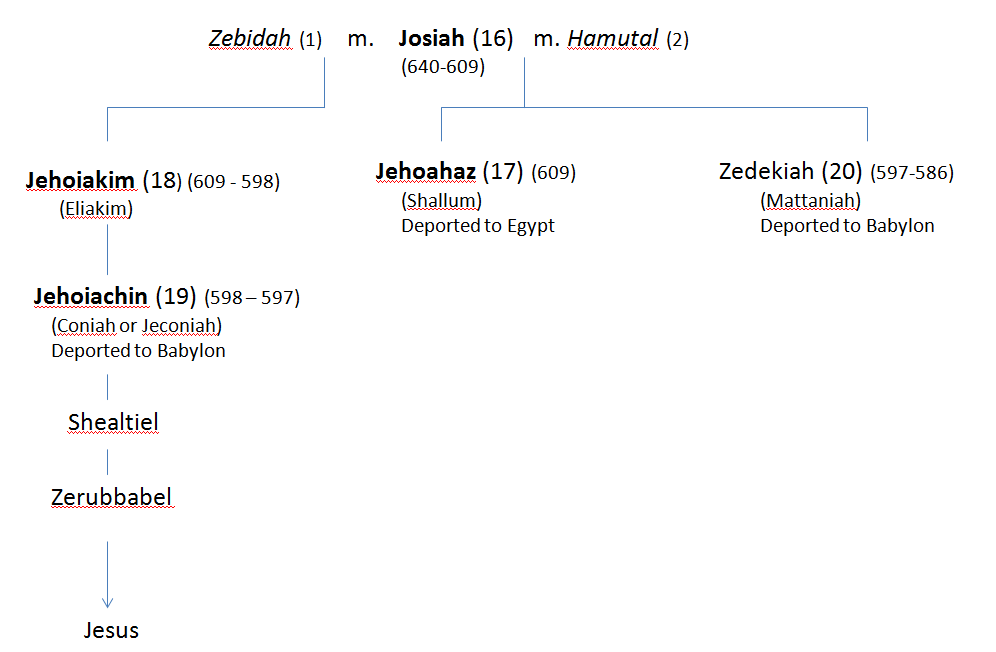
Jeremiah prophesied during the final five kings of Judah, Josiah, Jehoahaz, Jehoiakim, Jehoiachin and Zedekiah.
1) Josiah (641-609)
Josiah was the sixteenth king of Judah (640 - 609 BC), ruling for thirty-one years. He was son of Amon, an evil king who was assassinated, ending a two year reign. He was grandson of Manasseh, the worst king of Judah, who burned his sons in the fire to Molech and put idols in the temple (2 Chr 33:6).
Out of this dreadful background, came Josiah, a good king, upright and outstanding. “Before him there was no king like him, who turned to the Lord with all his heart and with all his soul, and with all his might, according to the law of Moses, nor did any like him arise after him” (2 Kg 23:25).
After the discovery of the book of the law in the temple, Josiah conducted major reforms, renewing the covenant and destroying idols and the high places. Josiah was killed in battle against Pharoah Necho at Megiddo, after reigning for 31 years (2 Kg 23:28-30).
2) Jehoahaz (Shallum) (609)
Jehoahaz was the second son of Josiah. His mother, Hamutal, was Josiah's second wife. He is called Shallum by Jeremiah (22:11). He was deported to Egypt by Pharaoh Necho after reigning for three months.
3) Jehoiakim (609-598)
His name was Eliakim, but was given the name Jehoiakim by Pharaoh Necho of Egypt, who made him king. He was the eldest son of Josiah, (son of his first wife) having been passed over when Jehoahaz became king. He died during the first siege of Jerusalem after reigning for eleven years. It was Jehoiakim who burned the original scroll of containing the prophesies of Jeremiah (Jer 36).
4) Jehoiachin (Coniah, Jeconiah) (598-597)
The son of Jehoiakim. His mother, Nehusta, was the queen mother (Jer 13:18 and 29:2). He was also called Coniah and Jeconiah. After reigning for only three months, he was deported to Babylon by Nebuchadnezzar, and later released (2 Kg 25:27-30). People continued to regard him as the legitimate king. His descendants continued the Davidic line, through Zerubbabel to Jesus (Mt 1).
5) Zedekiah (597-586)
His name was Mattaniah, but was given the name Zedekiah by Nebuchadnezzar. He was Jehoiachin's uncle. After reigning for eleven years, he was deported to Babylon by Nebuchadnezzar, who killed his sons and blinding him (2 Kg 25:7).
Family tree of last five kings of Judah
 �
�
Family of Shaphan
Shaphan and his family often appear through the book of Jeremiah, supporting Jeremiah in his conflicts with religious authorities and the king. It is interesting that all the members of this family supported Jeremiah in various ways.
Shaphan was the state secretary to king Josiah. In the 18th year of Josiah (622 BC), Josiah had sent Shaphan to the temple to see Hilkiah the high priest to ask him to give the money, collected from the people, to the man supervising the workmen rebuilding the temple for paying the workmen and to purchase materials (2 Kg 22:3-7).
Hilkiah told Shaphan that they had discovered the book of the law. Shaphan reported back to the king and gave him the book of law (2 Kg 22:8-10).
Shaphan and others (including his son Ahikam) sent to consult Huldah the prophetess who prophesied the doom of Judah (2 Kg 22:11-20, 2 Chr 34:8-33).
There is a Shaphan mentioned in Ezek 8:11, the father of Jaazaniah, seen in Ezekiel's vision of the temple, sacrificing to idols. This would certainly be a different person.
Shaphan had at least three sons
1) Ahikam
Ahiham assisted Jeremiah during his trial so Jeremiah was not put to death (Jer 26:24). He went with Shaphan to Huldah the prophetess (2 Kg 22:12, 2 Chr 34:20)
2) Elasah
Elasah carried Jeremiah's letter to the exiles in Babylon (Jer 29:3)
3) Gemariah
Gemariah was one of the king’s officials, who had a chamber in the upper court at the entry of the New Gate of the temple, where Baruch first read the scroll (Jer 36:10). He tried to stop King Jehoiakim from burning the scroll (Jer 36:10). A bulla (impression from a seal) was found in Jerusalem in 2005 belonged to Gemariah.
There is another Gemariah, the son of Hilkiah, the high priest, who accompanied Elasah to Babylon with the letter.
Shaphan also had 2 known grandsons
1) Gedaliah (Son of Akikam)
Gedaliah was the governor of Judah, based in Mizpah, under the Babylonians after the destruction of Jerusalem. Jeremiah was entrusted to him by the Babylonians (Jer 39:14). Gedaliah was murdered after three months in office by Ishmael who was sent by Baalis, the king of Ammon (Jer 40-41). His death was commemorated by a fast on the third of Tishri by the Jews (Zech 7:5, 8:19).
There is another Gedaliah, the son of Pashur, who opposed Jeremiah and had him put in the empty cistern (38:1)
2) Micaiah (Son of Gemariah)
Micaiah told the princes about the scroll having heard Baruch read it to the people (Jer 36:11,13)
Baruch (Son of Neriah)
Baruch was Jeremiah's faithful scribe. He was a witness to Jeremiah's purchase of the field in Anathoth from his cousin Hanamel while Jeremiah was in prison (Jer 32:12).
He wrote the original scroll, as dictated by Jeremiah (36:4,18), read it to the people because Jeremiah was banned from the temple (36:10) and to the princes, who warned him and Jeremiah to hide (36:15). He gave the scroll to Jehudi to be read to the king. After Jehoiakim burnt it, he ordered the arrest of Jeremiah and Baruch, who were hidden by the Lord. Jeremiah dictated the second scroll to Baruch (36:32).
After the fall of Jerusalem he lived with Jeremiah at Mizpah. He was arrested after the murder of Gedaliah by the Jews, accused of influencing Jeremiah to bring the word that they should stay and not go the Egypt (43:3). He and Jeremiah were taken to Egypt (43:6). Josephus suggests that Baruch and Jeremiah were taken to Babylon after the invasion of Egypt by Nebuchadnezzar in 583 BC.
Rabbinic tradition suggests that Baruch was Ezra's teacher. Because of his association with Jeremiah, some non-canonical apocryphal books have been given his name, including the Apocalypse of Baruch, and the The Book of Baruch (in the apocrypha).
His brother Seraiah was the quartermaster to King Zedekiah (Jer 51:59), who went into exile with the king. He was told to throw a copy of the book into the Euphrates (Jer 51:64)
The Princes - leaders of Judah
These are the king’s officials, and are listed in (36:12), when they listened to Baruch reading the scroll, and then sent Jehudi to read the scroll to Jehoiakim. Most of them had chambers in the temple.
1) Elishama
Elishama was secretary to the leaders of Judah, during the reign of Jehoiakim. The scroll was kept in his room before it was read to the king, Jehudi was sent back to get it (36:20).
2) Delaiah (Son of Shemaiah)
Delaiah heard the scroll being read by Baruch (36:12), and urged the king not to burn the scroll (36:25).
3) Elnathan (Son of Achbor)
Elnathan was sent by Jehoiakim to bring the prophet Uriah back from Egypt to be killed (26:22). He also was one of the three who urged Jehoiakim not to burn the scroll (36:25). A different Elnathan was the father of Queen Nehusta, the wife of Jehoiakim.
4) Gemariah (son of Shaphan)
Introduced above
5) Zedekiah (son of Hananiah) (not the false prophet)
This was obviously a different person from king Zedekiah.
Other people with chambers in the temple
Hanan's sons (Son of Igdaliah - the man of God)
These unnamed sons had a chamber near the chamber of the princes, above the keeper of the threshold, where Jeremiah met the Rechabites (35:4)
Maaseiah (Son of Shallum)
Was keeper of the threshold (35:4)
Other people - in alphabetical order
Ahab (Son of Kolaiah)
A false prophet in Babylon, who Jeremiah prophesied would be killed by Nebuchadnezzar, and was roasted in the fire (29:21)
Azariah (Son of Hoshaiah)
One of the commanders who asked Jeremiah to seek the Lord whether the remnant should flee to Egypt after the murder of Gedaliah (42:1, 43:1).
Ebed-melech (non Jewish)
The Ethiopian eunuch, who was a servant of King Zedekiah. He obtained the king's permission to release Jeremiah from the cistern, and so saved his life. Jeremiah promised in return that he would not be killed when the Babylonians captured Jerusalem (38:7-12, 39:16).
Gedaliah (Son of Pashur)
A leader of Judah, one of the group who had Jeremiah cast into the cistern to die (38:1).
Hanamel (Son of Shallum)
Jeremiah's cousin, who asked Jeremiah to redeem a plot of land in Anathoth. He bought it for 17 shekels as a sign that the people will return to the land (32:7-12).
Hananiah
There were several people named Hananiah.
1) Hananiah (Son of Azzur) - the false prophet
Hananiah was a prophet from Gibeon who appeared before the king, priests and people in the temple and proclaimed that the Lord had broken the yoke of Babylon, so Jehoiachin would be returning soon. Jeremiah disagreed with him, so Hananiah broke Jeremiah's wooden yoke bars. Jeremiah prophesied the Lord will make iron yoke-bars and that Hananiah would be dead within a year, he died two months later (ch 28).
2) Hananiah, father of Zedekiah, the prince (36:12)
3) Hananiah, grandfather of Irijah
Irijah was the guard who arrested Jeremiah and accused him of deserting the city (37:13)
Hilkiah
There two different people named Hilkiah
1) Hilkiah the high priest
Hilkiah was the high priest during the reign of Josiah. During the repairs of the temple, he discovered the book of the law which he gave to Shaphan, the secretary. He was part of the group sent by the king to Huldah the prophetess (2 Kg 22-23).
2) Hilkiah, the father of Jeremiah
Hilkiah was father of Jeremiah the prophet and member of the priestly family of Anathoth (Jer 1:1), who were probably descendants of Abiathar, David's high priest, expelled by Solomon for supporting Adonijah (1 Kg 2:26).
Irijah (Son of Shelemiah)
He was an army captain who arrested Jeremiah and accused him of deserting to the enemy when he left the city (37:13).
Ishmael (Son of Nethaniah, son of Elishama)
The murderer of Gedaliah. He was one of the five army captains who joined Gedaliah (40:8): Ishmael, Johanan (Son of Kareah), Seraiah (Son of Tanhumeth), Sons of Ephai the Netophathite and Jezaniah (Son of the Maacathite).
Two months later Ishmael was sent by Baalis, king of the Ammonites, and murdered Gedaliah (41:1-3). The next day he lured 80 men bringing offerings into Gedaliah's house and killed all but ten of them, who showed Ishmael where great stores of food were (41:1-8). He was pursued by Johanan but escaped to Ammon (41:11-18).
Jaazaniah (Son of Jeremiah, son of Habazziniah)
The leader of the faithful Rechabites, who refused to drink wine, used by Jeremiah as an example of faithfulness (35:3). He was not the son of Jeremiah the prophet, who was called by God to remain unmarried.
Jehoiada
A priest who was replaced by Zephaniah at the command of Shemaiah from Babylon (29:26).
Jehucal or Jucal (Son of Shelemiah)
He was sent by Zedekiah to ask Jeremiah to pray for him, when he predicted the return of the Babylonians (37:3, 38:1).
Jehudi (Son of Nethaniah, son of Shelemiah, son of Cushi)
Jeremiah sent him to Baruch to ask him to read the scroll to the princes then sent by Jehoiakim to fetch the scroll and read it, while the king burnt it (36:14-23).
Jerahmeel
He was a son of King Jehoiakim, who was sent by the king to seize Jeremiah and Baruch after he read and burnt the scroll (36:26).
Jezaniah (Son of the Maacathite)
One of the four army captains who joined Ishmael (40:8).
Johanan (Son of Kareah)
One of the four army captains who joined Gedaliah (40:8). He warned Gedaliah that Ishmael was plotting against him, and was ignored (40:13-16). After Gedaliah was murdered, Johanan pursued Ishmael, who escaped to Ammon (41:11-18). They asked Jeremiah to seek the Lord whether they should flee to Egypt because they thought they would be blamed for Gedaliah's murder (42:1-8), but ignored his answer, taking Jeremiah and Baruch to Egypt (43:2-5).
Jonadab (Son of Rechab)
The ancestor of the Rechabites, who had commanded them not to drink wine or to live in houses (35:8,14). They continued to obey his command not to drink wine, even when pressed by Jeremiah, but had come to live in Jerusalem because of fear of the Babylonian army.
Jonathan
He was secretary to the leaders of Judah during the time of Zedekiah. Jeremiah was held prisoner in his house after being arrested for deserting the city (37:15,20, 38:26).
Malchiah (Son of King Zedekiah)
He owned a cistern in the court of the guard in which Jeremiah was left to die (38:6).
Pashur
There were at least three people called Pashur.
1) Pashur (Son of Immer)
The chief officer in the temple, who heard Jeremiah preaching, beat him and put him in the stocks. Jeremiah gave him the name ‘Terror on every side’ and predicted he would go into exile in Babylon (Jer 20:1).
2) Pashur (Son of Malchiah)
He was sent by Zedekiah to inquire of the Lord, whether Nebuchadnezzar will withdraw (Jer 21:1). He was one of the group who opposed Jeremiah and had him cast into the empty cistern to die (Jer 38:1).
3) Pashur, father of Gedaliah (not the governor)
His son Gedaliah was one of the group who had Jeremiah cast into the cistern (Jer 38:1). He is probably either the first or second of the Pashurs above.
Seraiah
There were at least four people named Seraiah.
1) The chief priest during reign of Zedekiah.
After the fall of Jerusalem, he was taken before Nebuchadnezzar, who had them put to death (52:24-27).
2) Seraiah (Son of Tanhumeth)
He was a captain of the army, who joined Gedaliah after he was made governor (40:8).
3) Seraiah (Son of Azriel)
He was commanded by Jehoiakim to seize Jeremiah and Baruch after the burning of the scroll (36:26).
4) Seraiah (Son of Neriah, son of Mahseiah)
Baruch's brother. He was quartermaster to Zedekiah and was taken into exile with the king. Jeremiah gave him a copy of the prophecies against Babylon and told him to tie a stone to it and throw it into the Euphrates as a symbol of what will happen to Babylon (51:59-64).
Shelemiah
There were at least four people named Shelemiah.
1) Shelemiah (Son of Cushi)
His grandson, Jehudi read the scroll to King Jehoiakim (36:14).
2) Shelemiah (Son of Abdeel)
An officer of Jehoiakim, who was commanded to arrest Jeremiah and Baruch after the king had read and burnt the scroll (36:26).
3) Father of Jehucal, see above
4) Shelemiah (Son of Hananiah)
He was father of Irijah, the guard who arrested Jeremiah (37:13).
Shemaiah (Son of Nehelam)
A false prophet who had already been taken into exile. He wrote to Zephaniah the priest, making him priest instead of Jehoiada, telling him that the exile will soon end, and asking him to rebuke Jeremiah for prophesying a long exile. Jeremiah wrote back prophesying that Shemaiah will not live to see the return from exile (29:24-32).
Shephatiah (Son of Mattan)
A leader of Judah, one of the group who had Jeremiah cast into the cistern to die (38:1).
Uriah (Son of Shemaiah)
A prophet from Kiriath-jearim, who, like Jeremiah, also foretold the destruction of Jerusalem. He fled to Egypt to escape from Jehoiakim, who sent Elnathan and others to bring him back, where he was killed with the sword (26:20-23).
Zedekiah (Son of Maaseiah)
A false prophet exiled in Babylon, who along with Ahab was cursed by Jeremiah and predicted that they would be burnt to death by Nebuchadnezzar (29:21).
Zephaniah (Son of Maaseiah the priest) - a different Maaseiah
He became the second priest under Zedekiah (52:24). He was sent by Zedekiah to Jeremiah to ask him to inquire of the Lord whether Babylon will withdraw (21:1). He received a letter from Shemaiah from Babylon, making him priest in place of Jehoiada, telling him to rebuke Jeremiah for prophesying a short exile (29:24-29). He was sent by Zedekiah to as Jeremiah to pray for Judah (37:3). After the fall of the city, he was taken before Nebuchadnezzar at Riblah and executed (52:24, 2 Kg 25:18). He is not Zephaniah the prophet who wrote the book of Zephaniah.
�
Pharaoh's of Egypt
Neco or Necho (610 - 595 BC)
Necho was son of Psammetichus I, the founder of the 26th dynasty. He marched north with his armies to support the last king of Assyria against the Babylonians. King Josiah forced a battle with Neco at Megiddo, where he was killed (2 Kg 23:29, 2 Chr 35:20-24). On his return south, Neco deported Josiah's son Jehoahaz and appointed Jehoiakim as the vassal king of Judah, who had to pay tribute to Egypt (2 Kg 23:31-35, 2 Chr 36:1-4). Neco was defeated by the Babylonians at the Battle of Carchemish (46:2), and Judah came under the control of the Babylonians (2 Kg 24:1,7). In 601 BC, Nebuchadnezzar attempted to invade Egypt, as predicted by Jeremiah (46:13), but was defeated.
Hophra (589 - 570 BC)
He was the fourth king of the 26th dynasty. Zedekiah asked him to send forces to help him against Nebuchadnezzar (Ezek 17:11-21). The Egyptian armies arrived during the siege of Jerusalem (Jer 37:5), his retreat was predicted by Jeremiah (37:7, 44:3). The Babylonian army lifted the siege of Jerusalem in order to pursue the Egyptian army (37:11).
Babylonians
Nebuchadnezzar
The well-known King of Babylon, who besieged, captured and destroyed Jerusalem. His actual name was ‘Nabukadurriusur’ in Arcadian. His name is normally spelt Nebuchadrezzar in the book of Jeremiah.
Babylonian Officials
Nebuzaradan - The captain of the guard (40:1, 43:6)
He led the Babylonian army who attacked Jerusalem, then burned the temple, the king’s palace and all the houses, and demolished the city walls. He was in charge of the exile (39:9-10, 52:15-16,26-30). He was commanded by Nebuchadnezzar to look after Jeremiah and to do him no harm (39:12). He later handed him over to Gedaliah who he appointed as the governor.
Nergal-sharezer - The Rabmag (39:3,13)
The Rabmag was a Babylonian title meaning ‘Chief Magian’ or Chief of the Magi’, a high-ranking priest or wise man / magician in Nebuchadnezzar's court. He was present at the fall of Jerusalem. He was ordered by Nebuchadnezzar to release Jeremiah and to treat him well (Jer 39:13). He later became king of Babylon (560-556 BC) after killing his brother-in-law Evil-meredoch.
Samgar-nebo - prince of Babylon (39:3)
With the other Babylonian officials, he sat in triumph in the middle gate of Jerusalem after the Babylonian army had broken through the walls of the city (Jer 39:3).
Sarsechim - The Rab-saris (39:3)
He name means ‘master of the wardrobes’. He sat with the other officials in the middle gate of Jerusalem (39:3).
Nebushazban - The captain of the guard (39:13)
He was one of the officials responsible for the destruction of Jerusalem, and who placed Jeremiah into the care of Gedaliah (Jer 39:13).
Related pages